
Lake Conditions
Stay informed with the latest updates on Canyon Lake’s water quality, algae activity, and overall lake health. This page provides timely information to help residents understand current conditions, ongoing monitoring efforts, and any advisories that may impact recreation or lake use. Updates are posted as new data becomes available to ensure our community has clear, reliable, and up‑to‑date information on the health of our lake.
Golden Algae Monitoring
Density Trend Analysis
* Dots indicate reported data. If no dot is present, no data was reported for that location on that date.
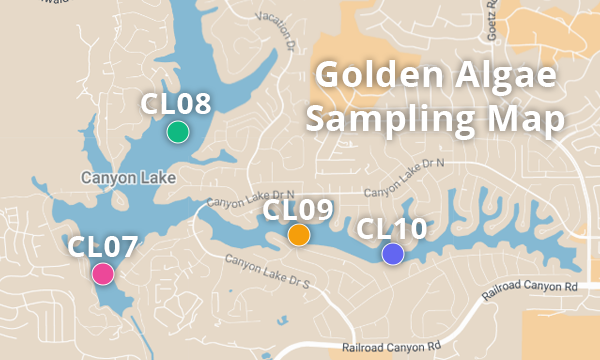
Golden Algae Test Results
Golden Algae Updates
Golden Algae Test Results
| Sample Date | Density Range (cells/mL) | Report |
|---|---|---|
| 5/20/2026 |
1,340 cells/ml in CL 10-GA 2,346 cells/ml in CL 09-GA 670 cells/ml in CL 08-GA 2,011 cells/ml in CL 07-GA |
View Full Golden Algae Screen Results |
| 5/5/2026 |
7,707 cells/ml in CL 10-GA 7,372 cells/ml in CL 09-GA 670 cells/ml in CL 09-5m 1,676 cells/ml in CL 08-GA 4,691 cells/ml in CL 07-GA |
View Full Golden Algae Screen Results |
| 4/21/2026 |
6,367 cells/ml in CL 10-GA 7,707 cells/ml in CL 09-GA 6,702 cells/ml in CL 08-GA 11,729 cells/ml in CL 07-GA |
Full Golden Algae Screen Results Coming Soon |
| 4/8/2026 |
12,399 cells/ml in CL 10-GA 9,718 cells/ml in CL 09-GA 670 cells/ml in CL 08-GA 3,351 cells/ml in CL 07-GA |
Full Golden Algae Screen Results Coming Soon |
| 3/25/2026 |
10,053 cells/ml in CL 10-GA 7,037 cells/ml in CL 09-GA 7,037 cells/ml in CL 09-GA-4m Zero golden algae cells/ml in CL 08-GA Zero golden algae cells/ml in CL 07-GA |
View Full Golden Algae Screen Results |
| 3/11/2026 |
13,739 cells/ml in CL 10-GA 12,399 cells/ml in CL 09-GA Zero golden algae cells/ml in CL 08-GA Zero golden algae cells/ml in CL 07-GA |
View Full Golden Algae Screen Results |
| 2/24/2026 |
12,064 cells/ml in CL 10-GA 19,436 cells/ml in CL 9-GA 50 cells/ml in CL 08-GA Zero golden algae cells/ml in CL 07-GA |
View Full Golden Algae Screen Results |
| 2/10/2026 |
16,035 cells/ml in CL 10-GA 13,090 cells/ml in CL 9-GA Zero golden algae cells/ml in CL 08-GA Zero golden algae cells/ml in CL 07-GA |
View Full Golden Algae Screen Results |
| 1/28/2026 |
13,069 cells/ml in CL 10-GA 9,383 cells/ml in CL 9-GA Zero golden algae cells/ml in CL 08-GA Zero golden algae cells/ml in CL 07-GA |
View Full Golden Algae Screen Results |
| 1/15/2026 |
14,726 cells/ml in CL 10-GA 2,356 cells/ml in CL 9-GA 1,649 cells/ml in CL 08-GA 471 cells/ml in CL 07-GA |
View Full Golden Algae Screen Results |
| 1/8/2026 |
17,090 cells/ml in CL 10-GA 6,032 cells/ml in CL 9-GA 38 cells/ml in CL 08-GA 75 cells/ml in CL 07-GA |
View Full Golden Algae Screen Results |
| 12/18/2025 |
10,723 cells/ml in CL 10-GA 4,356 cells/ml in CL 9-GA Zero golden algae cells/ml in CL 08-GA Zero golden algae cells/ml in CL 07-GA |
View Full Golden Algae Screen Results |
| 12/10/2025 |
4,356 cells/ml in CL 10-GA Zero golden algae cells/ml in CL 08-GA |
View Full Golden Algae Screen Results |
| 12/5/2025 |
6,032 cells/ml in CL 10-GA 3,016 cells/ml in CL 9-GA Zero golden algae cells/ml in CL 08-GA Zero golden algae cells/ml in CL 07-GA |
View Full Golden Algae Screen Results |
| 11/11/2025 |
335 cells/ml in CL-10 7 day surf Zero golden algae cells in CL-10 7 day bottom Zero golden algae cells in Holiday Harbor 7 day surf Zero golden algae cells in Holiday Harbor 7 day 4m |
View Full Golden Algae Screen Results |
| 11/05/2025 |
Zero golden algae cells per/mL in CL-10-48hr Zero golden algae cells per/mL in Holiday Harbor-48hr |
View Full Golden Algae Screen Results |
| 11/07/2025 |
Zero golden algae cells per/mL in CL-10-96hr Zero golden algae cells per/mL in Holiday Harbor-96hr |
View Full Golden Algae Screen Results |
| 10/13/2025 |
4,021 cells/ml in Holiday Harbor 6,367 cells/ml in CL-10 |
View Full Golden Algae Screen Results |
| 10/07/2025 | 4,021 cells/ml in CL-10 | View Full Golden Algae Screen Results |
| 9/30/2025 | 1,005 cells/ml in CL-10 | View Full Golden Algae Screen Results |
| 9/26/2025 | Zero golden algae cells per/mL in CL-10 | View Full Golden Algae Screen Results |
| 7/31/2025 |
Zero golden algae cells per/mL in CL-7 Zero golden algae cells per/mL in CL-8 Zero golden algae cells per/mL in CL-9 Zero golden algae cells per/mL in CL-10 |
View Full Golden Algae Screen Results |
| 7/09/2025 |
2,291 cells/ml in CL-07 3,600 cells/ml in CL-08 1,473 cells/ml in CL-08_5m 4,091 cells/ml in CL-09 4,909 cells/ml in CL-09_4m 3,763 cells/ml in CL-10 |
View Full Golden Algae Screen Results |
| 6/25/2025 |
982 cells/ml in CL-07 3,436 cells/ml in CL-08 2,291 cells/ml in CL-09 2,127 cells/ml in CL-10 |
View Full Golden Algae Screen Results |
| 6/11/2025 |
17,800 cells/ml in CL-07 Surf 14,480 cells/ml in CL-07 4m 11,900 cells/ml in CL-08 Surf 5,800 cells/ml in CL-08 3.5m 3,750 cells/ml in CL-09 Surf 1,300 cells/ml in CL-09 4m 16,350 cells/ml in CL-10 Surf 29,400 cells/ml in CL-10 4m |
View Full Golden Algae Screen Results |
| 5/23/2025 |
5,450 cells/ml in East Bay 8,700 cells/ml in Indian Beach Park |
View Full Golden Algae Screen Results |
Algaecide Treatment
Algaecide Treatment
Algaecide Treatment to Address Golden Algae
Posted November 7, 2025
The golden algae treatment is complete, and water quality continues to improve. The lake will reopen on Sunday, November 9, for all recreational activities. Thank you for your patience and cooperation as we worked to protect the health of our lake.
Posted October 29, 2025
Based on current algae cell counts and manufacturer recommendations, only 50% of the water will be treated per day to maintain healthy dissolved oxygen levels. Material will be stored in Holiday Harbor’s parking lot, utilizing about 25% of the parking spaces.
EAST BAY
-
Monday, November 3: Treat 50% of the surface (upper water column).
-
Tuesday, November 4: Treat the remaining 50% of the subsurface using a pipe positioned about 10 to 12 feet below the surface (lower water column).
-
East Bay will be fully treated over two days, eliminating the need for a second application or closure later in the month.
MAIN LAKE
-
Begins Monday, November 3, with a second boat.
-
Treatment is expected to take approximately four days total.
LAKE CLOSURE NOTICE:
Members should expect the lake to be closed Monday, November 3, through Sunday, November 9. The schedule may adjust based on progress, and updates will be shared as plans develop.
Posted October 27, 2025
Due to material delivery constraints, the Golden Algae treatment will start on Monday, November 3. Material will be stored in the Holiday Harbor Parking lot and will take up approximately 25% of the parking spaces there. Applicators will start in East Bay and should complete East Bay on Monday. Main lake will likely start on Tuesday, November 4, and may take two days. Members should expect the lake to be closed during and after the treatment, November 3-6. We will provide further updates as they become available.
Posted October 24, 2025
The Canyon Lake POA and EVMWD are partnering to conduct a chelated copper algaecide treatment on the lake as early as late next week. This work coincides with the lake’s natural seasonal turnover, a process that can temporarily change water color, clarity, or odor as cooler surface water mixes with deeper layers. This proactive measure is being taken to help reduce the growing presence of golden algae and support the overall health of the lake ecosystem. The treatment will occur in two applications, approximately two weeks apart.
In the most recent sampling results, taken on October 22, golden algae density counts collected show an increase from samples taken earlier this month. GEI Consultants reported levels between 4,356 and 10,723 cells/ml in the Main Lake. East Bay results rose to 14,745 cells/ml. For comparison, samples collected on October 13 recorded 4,021 cells/ml at the Main Lake Holiday Harbor Dock and 6,367 cells/ml at the East Bay Indian Beach Dock.
The treatment will be applied at a concentration that is safe for boats, people, fish, and other aquatic life. Swimming, boating, and all water contact will be temporarily restricted for up to 72 hours during and following each treatment as a precaution and to ensure unobstructed application procedures. This application is expected to improve current water quality conditions and reduce the risk of future fish mortality. Please note that while this treatment is intended to reduce the algae, golden algae can reappear when environmental factors such as temperature and rainfall become favorable.
We appreciate the community’s cooperation and understanding as we work together to create a healthy and thriving lake environment.
Algaecide Treatment FAQ
Why is this action being taken now?
Over the last two decades, golden algae blooms have become a growing issue across the western United States. Canyon Lake experienced its first bloom this past spring, which resulted in significant fish mortality. Golden algae prefer cooler water, so as lake temperatures rose over the summer, the algae went dormant and live cell densities decreased. As air and water temperatures declined in recent weeks, golden algae levels are rising again. Using data collected in Canyon Lake, environmental and water quality experts recommended an early, preemptive treatment to help reduce the algae before conditions worsen.
Are there even any fish remaining in the lake after the spring bloom?
Yes. An acoustic underwater survey conducted last week confirms that Canyon Lake continues to support an improving fish population, with more than 2,300 medium-sized fish detected in the East Bay alone.
Isn’t copper harmful to fish? Can it further impact the lake environment negatively?
When used at the recommended dosage, copper is safe to apply to lakes and has been widely used throughout the United States to reduce algae biomass. Chelated copper algaecides are less toxic to fish and other aquatic life compared with traditional copper sulfate. The chelated form binds copper ions, limiting the amount of free copper in the water column. Using lower concentrations, especially at cooler water temperatures, provides the best environmental protection.
Is this treatment harmful to other wildlife that use the lake?
At the recommended application dosage, studies show minimal to no impacts to waterfowl, pets, or people.
How long will the lake be closed to body contact, water sports, and boating?
The algaecide application will occur in two doses separated by about two weeks. Out of an abundance of caution, the lake will be closed to all activity except Marine Patrol and the application boats for up to 72 hours during and following each application.
Is the current golden algae bloom due to the recent alum treatment?
It is unlikely. Alum is used to remove nitrogen and phosphorus that enter the lake after rainfall. Blue-green algae thrive in nutrient-rich conditions. Golden algae, however, produce cysts that settle at the bottom of the lake and bloom when environmental conditions such as lower water temperatures are favorable.
Will the treatment prevent future golden algae blooms?
Possibly. Chelated copper is effective in immediately reducing golden algae and the severity of other algal blooms. Without this treatment, and the seasonal shift toward cooler temperatures that favor golden algae growth, conditions could allow the bloom to persist through the winter and into late spring. The algaecide works by disrupting the metabolic processes of algae, preventing it from multiplying and taking over the water. There is no guarantee it will prevent future blooms when the right environmental conditions occur.
Who is paying for this treatment?
The cost of the lake treatment will be shared between the Canyon Lake POA and EVMWD, with additional technical expertise provided by the Metropolitan Water District and third-party consultants.
When will the lake be restocked?
Restocking will be considered once the results of the algaecide application are measured and golden algae cells and toxins are no longer present.
Harmfal Algal Bloom (HAB) Tests
Harmful Algal Bloom (HAB)
Current Lake HAB Test Results
Lake water samples were sent for Harmful Algal Bloom (HAB) testing on August 23, and no detections of harmful bacteria were found.
| Canyon Lake Location | Sample Date | Collected By | Microcystins | Anatoxin a | Cylindrospermopsin |
|---|---|---|---|---|---|
| Happy Camp | 8/23/2025 | CLPOA | ND | ND | ND |
| Sierra Park | 8/23/2025 | CLPOA | ND | ND | ND |
| Sunset Beach | 8/23/2025 | CLPOA | ND | ND | ND |
| Holiday Harbor | 8/23/2025 | CLPOA | ND | ND | ND |
| Indian Beach | 8/23/2025 | CLPOA | ND | ND | ND |
ND = Non detect. Detected concentrations are in micrograms per liter (μg/L).
| Level | Microcystins | Anatoxin a | Cylindrospermopsin |
|---|---|---|---|
| Safe | Below 0.8 | Below 1 | Below 1 |
| Caution | 0.8 to 5.9 | 1 to 19.9 | 1 to 3.9 |
| Warning | 6 to 7.9 | 20 to 89.9 | 4 to 14.9 |
| Danger | 8 or above | 90 or above | 15 or above |
Lake Testing Results Press Release - June 28, 2025 (PDF)
Full 06.25.2025 Pre-Holiday HAB Test Results from Eurofins Environmental Testing (PDF)
Canyon Lake Algae Blooms
As with any lake, ocean, or river in the nation, Canyon Lake’s aquatic ecosystem cannot be compared to a swimming pool that is treated with chemicals to ensure water quality. If you choose to use the lake for swimming, keep in mind that natural lake processes occur and there may be times that the water quality for recreation may pose a health risk.
- Canyon Lake Algae Blooms Facts (PDF) - Updated July 2021
Lake Algae FAQ
What are algae
Algae are photosynthetic organisms (plants) found naturally in marine and freshwater environments. They produce their own food through photosynthesis and are vital for the well-being of marine and freshwater ecosystems.
Who manages algae concerns in Canyon Lake?
The Lake Elsinore and San Jacinto Watershed Authority (LESJWA) was formed to improve water quality in Lake Elsinore and Canyon Lake. This organization is made up of stakeholders from around the watershed who are implementing programs such as the alum treatments to Canyon Lake. Many of these programs are grant funded and are a result of numerous lake studies.
Who is responsible for lake warning or closures based on the risk of Cyanobacteria or toxins?
The Canyon Lake POA and EVMWD have partnered on the development and implementation of an HAB monitoring and sampling program. The Canyon Lake POA will post signs based on varying risk levels, and for closing/reopening the lake in response to known conditions.
When do algae bloom?
Conditions for algae blooms are ideal when there is an oversupply of nutrients in a lake, such as phosphorus and nitrogen from lawn fertilizers, high temperatures, low oxygen levels in the water, little water movement, and low water levels. Algae blooms result when phytoplankton, organisms living on water surfaces, reproduce rapidly and cause dense buildups. In a balanced ecosystem, phytoplankton are the food base for many other organisms. However, with an oversupply of nutrients, they experience excessively high growth rates that result in algal blooms.
Are algae harmful?
In a balanced ecosystem, most algae are necessary to keep a body of water healthy and productive. However, excessive algae growth reduces water clarity, releases a strong odor, and suffocates aquatic life forms by depleting oxygen levels and blocking sunlight.
What is blue-green algae?
While BGA looks very similar to normal algae, it is actually not an algae at all, but a cyanobacteria naturally found in fresh and salt water systems. Cyanobacteria have existed in water bodies for centuries and our understanding of them and detection of toxins has improved in recent decades. Similar to algae, cyanobacteria use photosynthesis, as well as nitrogen and phosphorus for food. Not all BGA blooms are harmful, as only a few very specific strains produce toxins that can result in moderate to severe health complications in humans and animals. Toxicity of the algae bloom cannot be detected by simple observation and requires a collection of water samples and lab analyses.
What should I do if I see an algae bloom?
Refrain from going into water that is foamy, scummy, pea-green, blue-green, brownish red, or looks like floating paint.
When In Doubt, Stay Out!
Do not allow children or pets to play in or drink the water until the algae bloom subsides and drops to the lake bottom. If pets swim in water tinted with an algae bloom, rinse them off immediately. Water with mats of algae should not be used for cooking, even if it is filtered or boiled.
Do alum treatments help?
Yes. The alum treatments are designed to reduce the phosphorus levels in Canyon Lake. Common sources of phosphorus include fertilizers, pet waste, natural mineral erosion, and existing lake sediment. Phosphorus is often the limiting nutrient for algae, therefore removal of it will likely reduce algae growth.
Why hasn't the alum applications prevented algal blooms in the coves?
In some situations, where lake waters are particularly stagnant and shallow as evident around lake coves, algae growth may still occur despite repeated alum treatment. Usually, the algae mats in the coves will dissipate over time and drop away within 2 to 3 weeks.
How can I help reduce algae?
Yes, together we can all help reduce nutrient inputs to the lake by picking up after our animals, reducing runoff from our irrigation, reducing fertilizer use, and avoid littering in our streets. All of these practices reduce the amount of pollutants that end up in Canyon Lake, which can lead to algae growth.
Does algae affect drinking water?
Canyon Lake is a drinking water reservoir that EVMWD seasonally utilizes to offset costly imported water. After proper treatment, algae does not have any negative health impacts, but can add an earthy taste to drinking water.
Who tests the lake for algae?
In recent years, algae testing has been conducted at Canyon Lake by the Southern California Coastal Water Research Project (SCCWRP) and LESJWA. These tests are not required by State or Federal law and are used for research purposes to help improve water quality.
LESJWA Strategic Plan
Healthy Lakes, Connected Communities
A Strategic Plan for the San Jacinto River Watershed 2025
Click here to read the current Lake Elsinore San Jacinto Watershed Authority (LESJWA) strategic lake health plan. LESJWA is responsible for water quality in Lake Elsinore and Canyon Lake. The CLPOA is not a public agency stakeholder who pays into funding for LESJWA, but we work closely with them. For more information on this plan, please contact LESJWA at 951-354-4220.
Current Lake Updates
Update to Boat Owners Regarding Aluminum Pontoon Corrosion Reports
March 5, 2026
The Canyon Lake POA has issued an important update regarding recent reports of aluminum pontoon corrosion. While the exact cause has not yet been determined, early findings indicate multiple potential contributing factors including unprotected or scratched aluminum surfaces, improper or ineffective sacrificial anodes, stray electrical current, prolonged water exposure, and natural galvanic reactions under certain lake conditions.
Click Here To Read Full Update
Golden Algae Test Results Update
January 14, 2026
Results from water samples collected on Thursday, January 8, 2026, show that golden algae remains present and continues to be closely monitored, with higher readings at the same locations compared to the December test dates. pH levels have been trending upward across the monitoring sites; however, dissolved oxygen levels are within the normal range for this time of year, which is an encouraging sign for overall lake conditions. At this time, no fish kills have been reported. Monitoring and testing will continue, and additional toxicity testing will also be added as a precaution.
Aluminum Corrosion
January 14, 2026
There have been reports regarding aluminum corrosion on some pontoon boats. Based on expert input to date, it remains unlikely that the low-dose chelated copper algaecide applied for golden algae is the cause. Instead, galvanic corrosion/electrolysis is more commonly associated with a combination of environmental and mechanical factors, including:
- Stray electrical current (often from non-marine battery chargers or electrical cords in the water).
- Rising pH levels
- Protective anodes on boats that are worn, missing, or not working properly (these parts are designed to protect metal components by corroding first). If they aren’t functioning as intended, corrosion can occur. Members may want to check their anodes and consult a marine professional about the best option for their boat. As an example, Zinc anodes, typically factory-installed on boats and motors, can become oxidized and rendered ineffective in freshwater, and magnesium or aluminum anodes are preferred for freshwater.
https://www.city.kodiak.ak.us/ph/page/marine-electrolysis-galvanic-corrosion
Learn more about choosing the right Anodes
https://martyranodes.com/choosing-the-right-anode
Learn more about Sacrificial Anodes
https://www.svb24.com/en/guide/sacrificial-anode-guide-invisible-protection-for-yacht-boat.html